07 / 08
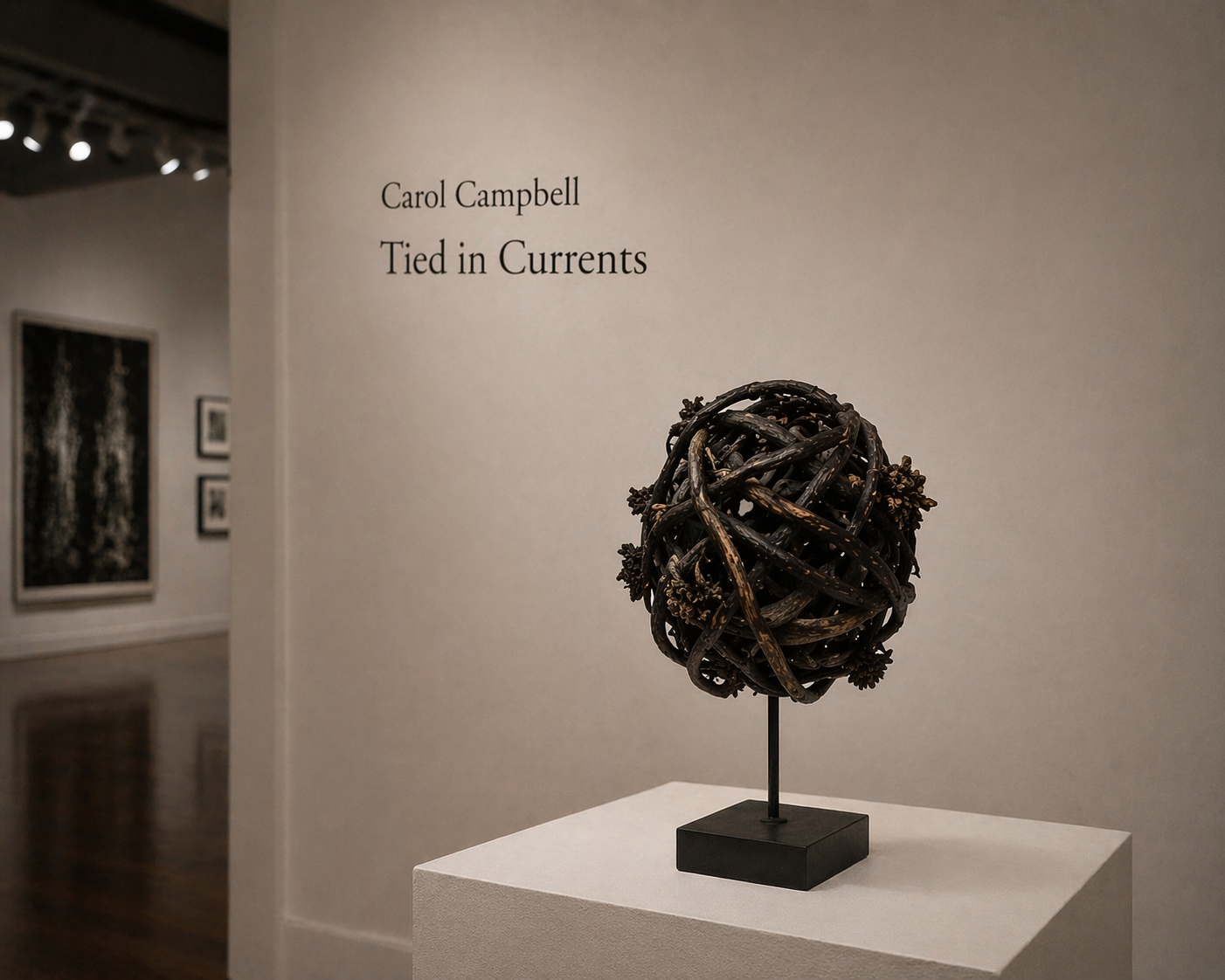
Tied in Currents
$2,400
Available
07 / 08
The kelp bulb — the pneumatocyst, the float — is the ocean's own sphere. Filled with gas to keep the kelp upright in the current, it is a small miracle of biological engineering: a globe sealed against the sea, bobbing at the margin between depth and light. I have held thousands of them in my hands over the years, each one slightly different in size and colour and the texture of its skin, but each one the same idea: a world enclosed, a breath held, a form that contains its own buoyancy.
Tied in Currents began as an attempt to understand what it means to make a perfect thing. The sphere is philosophically troubling — it has no beginning and no end, no front and no back, no hierarchy of surfaces. Every point on its skin is equidistant from the centre. It is the shape that contains the most volume for the least surface area, which is another way of saying it is the most efficient shape the universe knows. I wanted to make one from kelp, which is the least geometric material I work with — wild, irregular, indeterminate in length and diameter, shaped by random accident of growth and tide.
The weaving took six weeks. I used a core of wicker to give me a scaffold, then worked the kelp in long spiralling passes, wetting and pressing and waiting, building up layer after layer until the geometry emerged from the chaos. The finished sphere has a slight wobble in it — you can see, if you look closely, where the kelp insisted on its own logic rather than mine. I left those moments in. They are the most honest parts of the piece.
The iron pedestal lifts the sphere into the room's airspace, makes it hover at the height of a head. Standing beside it, you feel briefly as if you are underwater, looking up at something floating above you. A breath held. A tide about to turn.